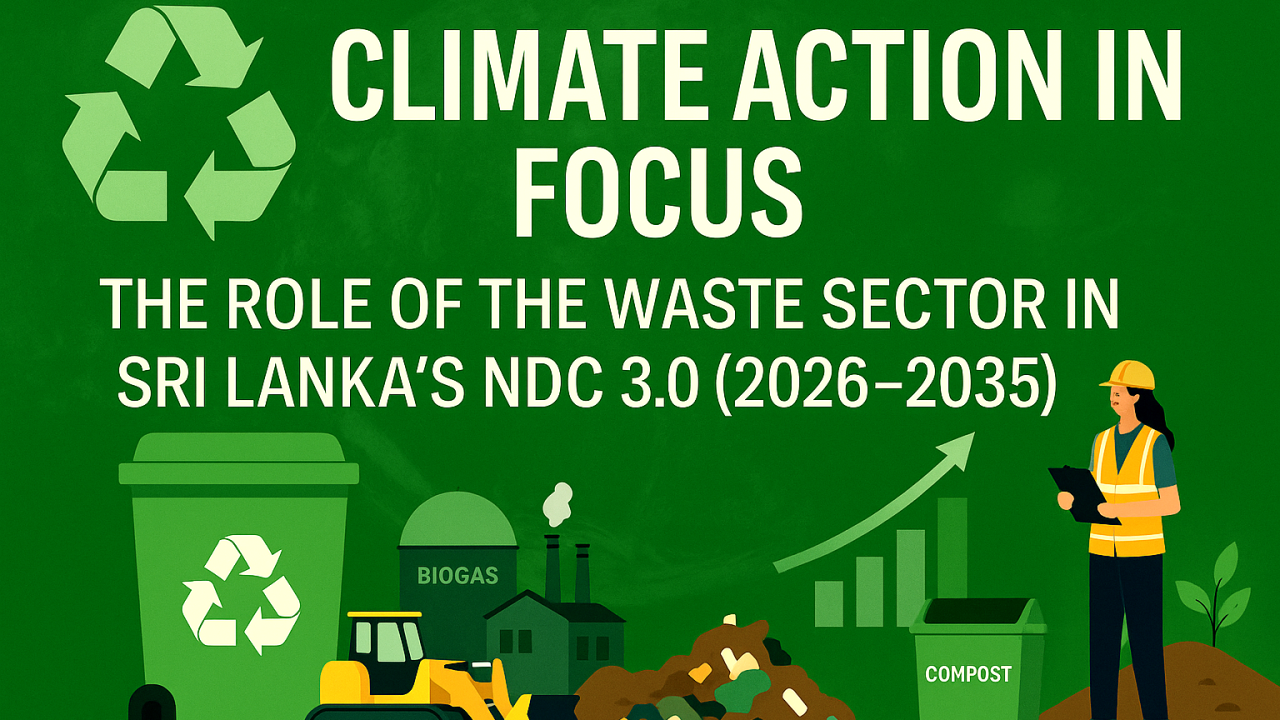
Climate Action in Focus: The Role of the Waste Sector in Sri Lanka’s NDC 3.0 (2026–2035)
Climate change is no longer a distant threat—it is a defining challenge of our era. As a small island nation acutely exposed to rising temperatures, erratic rainfall, and coastal flooding, Sri Lanka has reaffirmed its global climate leadership through the submission of its third Nationally Determined Contributions (NDC 3.0) for 2026–2035 (Ministry of Environment, 2025).
At Central Environmental Testing and Consultancy PVT Ltd. , an environmental-engineering firm committed to sustainable innovation, we view this roadmap as both a national commitment and a call to engineers, scientists, and communities to act. Among the six mitigation sectors, one often under-discussed area—the waste sector—presents both a pressing challenge and a powerful opportunity for climate action.
🌍 From Global Commitments to Local Action
The Paris Agreement calls on all nations to keep global temperature rise well below 2 °C, ideally 1.5 °C. Nationally Determined Contributions (NDCs) are each country’s blueprint for meeting that goal.
Sri Lanka’s NDC 3.0, published in September 2025 (Ministry of Environment, 2025), builds on earlier submissions (2016 and 2021). It targets a 20.09 % reduction in greenhouse-gas (GHG) emissions by 2035 relative to a Business-as-Usual (BAU) scenario—8.11 % unconditional (domestic effort) and 11.98 % conditional (dependent on international finance and technology).

Source: Ministry of Environment (2025), NDC 3.0, Figure 4-1.
While the energy and transport sectors dominate emission profiles, the waste sector offers one of the fastest and most cost-effective pathways for near-term mitigation (Ministry of Environment, 2025).

Waste Sector GHG Emission Projection and Reduction Targets (Source: Ministry of Environment (2025), NDC 3.0, Figure 4-4.)
In Sri Lanka’s NDC 3.0 framework, UC (Unconditional) and C (Conditional) represent two levels of emission-reduction commitments.
- Unconditional (UC) reductions refer to actions that Sri Lanka commits to undertake using domestic resources, policies, and technologies, without relying on external financial or technical assistance.
- Conditional (C) reductions are additional commitments that can be achieved with international support, including climate finance, technology transfer, and capacity building.
🗑 Waste-Sector Targets under NDC 3.0
According to Chapter 4.2.4 of the NDC 3.0 document, the waste sector will deliver cumulative unconditional (8.6%) and cumulative conditional (12.2%) GHG emission reduction targets for the ten-year period from 2026 to 2035 against the baseline (i.e. BAU scenario from historical base year 2010 to end 2035).
Key Mitigation Approaches include:
- Integrated Waste-Management Systems – expanding decentralized & centralized composting plants; promoting waste-to-energy and biogas/biomethanation for organic waste.
- Circular-Economy & 3R ( Reduce | Reuse | Recycle ) – strengthening source segregation and material-recovery facilities.
- Extended Producer Responsibility (EPR) – enforcing packaging & e-waste take-back schemes and incentivizing eco-design.
- Landfill Gas & Leachate Management – methane capture for energy, improved liners, and leachate treatment.
- Capacity Building & Public Awareness – national-scale waste-segregation campaigns and CBO training (Ministry of Environment, 2025).

NDCs in Waste Sector (Mitigation)
🧠 Technology and Capacity Development for a Climate-Smart Waste Sector
Sri Lanka’s NDC 3.0 emphasises that achieving the waste-sector mitigation targets will depend not only on infrastructure, but also on technological innovation and human capacity. The plan calls for the introduction of root-cause analysis (RCA) tools at the local level and the strengthening of integrated waste-management systems to improve resource efficiency through circular-economy practices.
Key technology needs include:
- Expanding decentralised composting and biogas facilities with quality-control systems.
- Advancing engineered landfills with methane-recovery systems.
- Developing robust MRV (Monitoring, Reporting, and Verification) systems for waste-sector GHG emissions.
At the same time, the NDC highlights that effective waste management requires strong digital interfaces, ICT integration, and skilled human capital. This includes training programs on circular-economy practices across the entire project life cycle—from design to operation and end-of-life management.
Importantly, NDC 3.0 underscores inclusion and equity by calling for programs that ensure women, youth, persons with disabilities (PWDs), and marginalised groups have equitable access to green jobs and climate technologies. Collaboration with academia, research institutions, and private-sector innovators will be essential to drive applied research and create locally appropriate, climate-smart waste-management solutions.
🛠 Engineering Pathways to NDC Delivery
Environmental engineering lies at the heart of this transformation. At Central Environmental Testing and Consultancy PVT Ltd., we support municipalities and industries through:
- Design & construction of composting and anaerobic-digestion plants.
- Sensor-driven monitoring for emissions and leachate control.
- Feasibility studies & climate-smart infrastructure consultancy.
- Life-cycle assessment (LCA) for quantifying GHG savings and resource recovery.
Our emphasis is on scalable, community-driven projects that unite technology and social impact—from rural composting hubs to smart waste to energy clusters integrated with renewables (Ministry of Environment, 2025).
💬 A Collective Call to Action
Sri Lanka’s waste-sector NDCs can succeed only through collaboration:
🔹 Government agencies – mainstream NDC-linked waste policies and funding.
🔹 Private sector – invest in innovation & EPR models.
🔹 Communities & CBOs – champion behavior change at source.
🔹 International partners – offer finance, technology, and capacity support.
Let’s transform waste from an environmental burden into a climate solution.
🚀 Looking Ahead
The decade 2026–2035 will test our resolve. NDC 3.0 has set a clear path—success depends on how effectively we engineer, finance, and monitor results.
At Central Environmental Testing and Consultancy PVT Ltd., we stand ready to partner with government and industry to turn ambition into action—one compost bin, biogas plant, and zero-waste policy at a time.
🔗 Reference
Ministry of Environment, Sri Lanka (2025). Sri Lanka’s Nationally Determined Contributions (NDC) 3.0 (2026 – 2035). Ministry of Environment, Battaramulla. Available online at https://unfccc.int/node/650098 (accessed October 2025).