A Small Price for a Big Change: Sri Lanka’s Plastic Bag Pricing Policy from November 2025
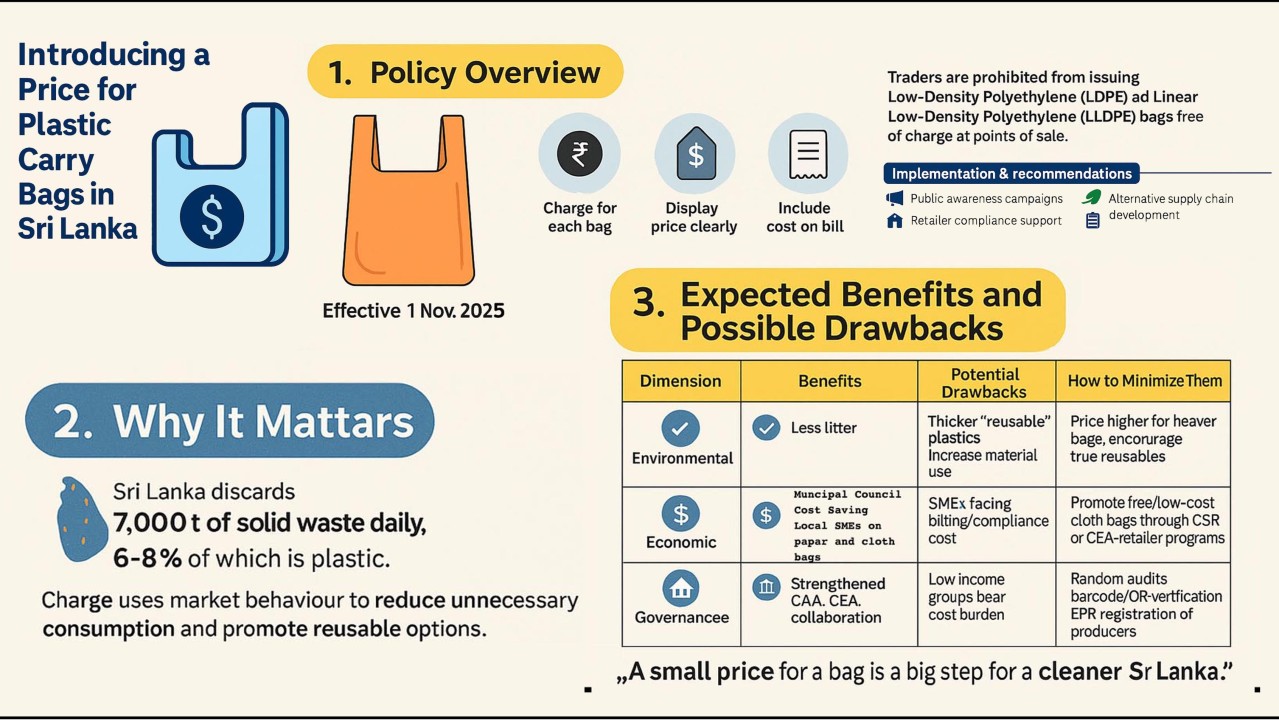
From 1 November 2025, Sri Lanka will take an important step toward cleaner cities and a lower carbon footprint. Under Direction No. 95 of the Consumer Affairs Authority (CAA), retailers will no longer issue LDPE or LLDPE plastic carry bags free of charge. Each bag must be sold at a visible price, clearly displayed at the counter, and printed on the customer’s bill.
This measure complements the Central Environmental Authority (CEA)’s single-use-plastic phase-down and supports the National Waste Management Policy (2019) and Sri Lanka’s National Determined Contribution (NDC) Commitments.
Why This Policy Matters
Sri Lanka generates around 7 000 t of solid waste per day, with plastics accounting for 6–8 % of the total stream — a major contributor to urban drainage blockage, flash flooding, and microplastic pollution [IPEN 2020; MDPI 2023]. Beyond litter, plastics also increase the carbon footprint of the waste sector through fossil-fuel-based production and poor end-of-life handling.
Recent life-cycle assessment (LCA) studies have found that:
- Single-use LDPE/HDPE bags have low mass per item but high cumulative impact because of enormous consumption.
- Reusable polypropylene non-woven (PNB) bags show the lowest total impact if reused ≥ 50 times, reaching break-even after about 4 uses
- Paper and cotton bags can have 15–80 × higher GWP if rarely reused, due to energy-intensive manufacture
- Recycling and reuse dramatically reduce total emissions compared with landfilling or incineration.
What the World Has Learned
- Ireland (2002 Levy): A €0.15 per-bag charge cut use > 90 % in year 1; revenues fund environmental projects.
- United Kingdom (2015 Charge): > 98 % reduction in major supermarkets once small fees applied; extended to all businesses (DEFRA 2023).
- Kenya (2017 Ban): Strong penalties reduced litter; counterfeit “biodegradable” bags highlight need for monitoring (UNEP 2019).
- Rwanda (2008 Ban → 2019 Law): Integrated enforcement via customs + awareness kept compliance high (World Bank 2020).
- Bangladesh (2002 Ban): Targeted drain blockages; consistent enforcement still key.
- EU Directive 2019/904: Combined pricing, EPR, and consumer-information for systemic change.
These experiences prove that pricing, reuse, and enforcement together—not bans alone—drive long-term behaviour change.
Expected Impacts for Sri Lanka

Integrating Climate and Waste Goals
- Embed Reuse > Recycle > Dispose across communication.
- Maintain film-recycling capacity to avoid contamination losses.
- Track bags avoided + CO₂e saved in annual NDC updates.
- Publish durability standards for reusable bags (fabric GSM, stitching, handle strength).
Key Message
💬 “A small price for a bag can mean a big cut in plastic waste and carbon emissions.”
Sri Lanka’s new policy is a behavioural nudge that—paired with reuse, recycling, and awareness—can significantly reduce plastic leakage and emissions while building a more circular economy.
References
Sri Lanka Waste Data
- IPEN Country Report (2020) – Sri Lanka generates ~7 000 MT/day of solid waste; plastics ≈ 6–8 %.
- Ranatunga R. et al., Sustainability (MDPI) 2023 – MSW generation 6 500–7 000 t/day.